
EXPLORE OUR COLLECTION
Search for stories
EXPLORE BY THEME
Oral History Thematic Snapshots

SPACES
Spaces where LGBTIQ people have met in Sydney's past have been varied and spread across the city. They include Beats, some workplaces, 'known' pubs and coffee shops. Venues began in the early 60s and later pubs, discos and night spots run by homosexuals sprung up. These quickly diversified to meet the needs of the community.
Some suburbs became associated with the the community and clusters of venues fostered gay neighbourhoods. Community dances began with camp social clubs and went on to include fundraising events for activism. By the 80s, the venues and the parties had expanded.

MARDI GRAS
The first parade was an attempt to get the bar goers involved in an open display and celebration of homosexuality and ended in a riot with police.
People involved with the next few parades feared impending police arrests but eventually changing social attitudes saw the Mardi Gras increasingly embraced by the wider population. Today it is a hugely popular display of LGBTIQ identity and struggle.
ACTIVISM
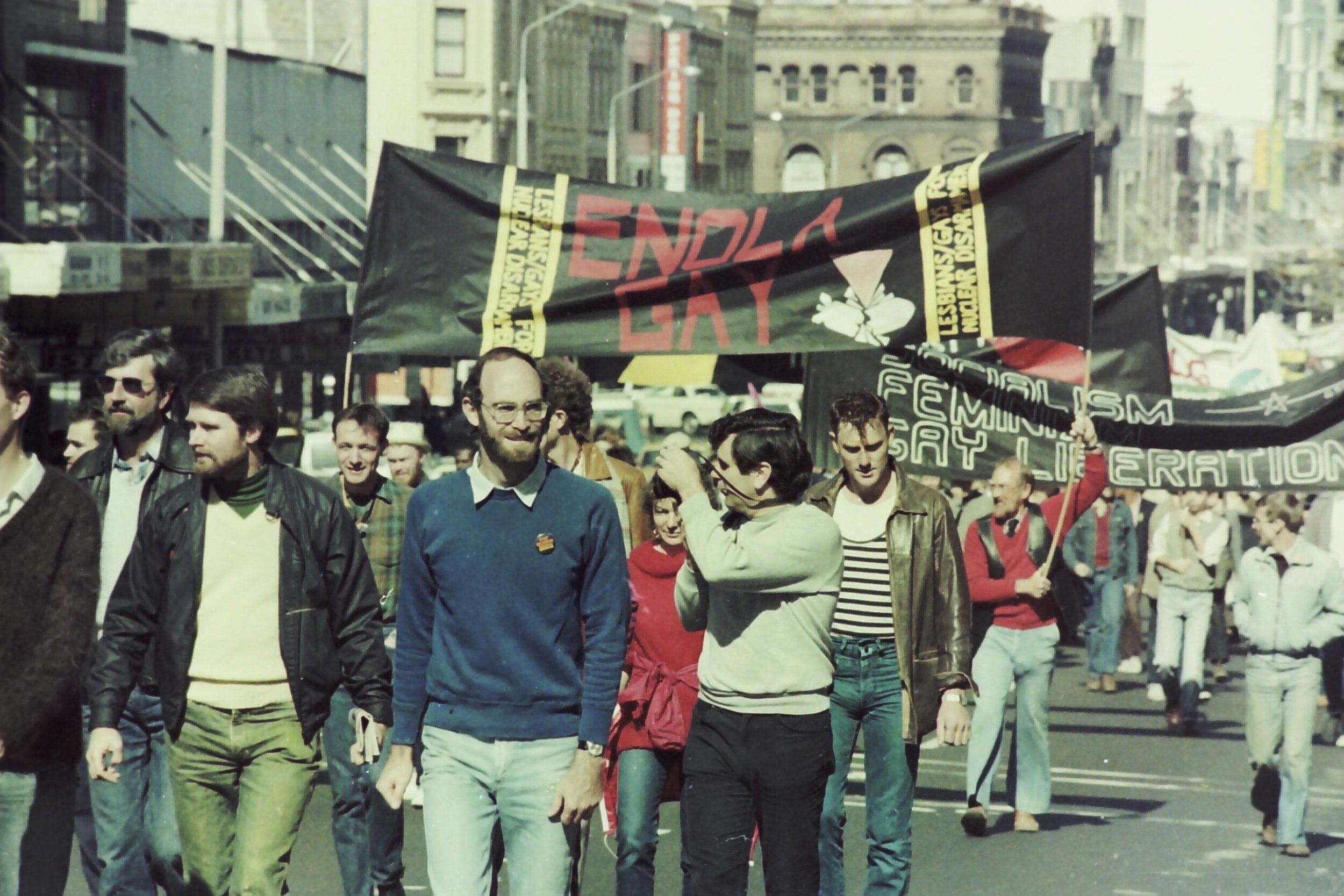
Anti-homosexual laws, alongside broader homophobia and transphobia, ruined the lives of many men and women who were arrested, bashed or 'treated'. LGBTIQ people responded by creating an underground homosexual and transgender world.
A movement for lesbian and gay rights began with the founding of CAMP Inc and Sydney Gay Liberation. The straight world saw gays in demonstrations and protests as a result.
The movement branched into counselling, Women’s Health Centres, media, national conferences, law reform and Mardi Gras.

DIVERSITY
Prior to the birth of the activism, many homosexuals and transgender people in Sydney called themselves ‘camp’. As it does today, language and ways of expressing sexuality and gender continued to evolve. The ‘Gay’ identity was adopted by many, with an emphasis on ‘coming out’ as a means to changing society and the law.
Sexism and racism were systemic in the broader society and even within the gay community. From the early 70s the identities of what was once ‘gay’ tumbled out – Lesbian, Lesbian feminist, Radical Faeries, Clones, S & M, Leather, Transgender, Intersex and Queer etc.

FRIENDSHIP CIRCLES
From the early 60s to the mid 70s, camp social clubs provided events for homosexual women and men and transgender people from all walks of life to gather and be themselves.
Groups like the Chameleons organised drag nights while Pollys held a range of social events such as the Polympics. There were social clubs that organised trips away or motorbike clubs who went on bike runs.

ARTS AND CULTURE
The LGBTIQ community has long used art and performance to express themselves and showcase their creativity. It has also been intertwined with political activism and advocacy. From drag to music and literature, art and culture provided a way for the community to come together and share their experiences and hope for a society free from discrimination.

HIV AND AIDS
The arrival of HIV/AIDS in Australia presented the LGBTIQ community with enormous challenges, including the loss of friends and loved ones, difficulties involving life-saving medication and social prejudice.
Activists and community groups responded quickly and decisively to HIV/AIDS, providing care, support and remembrance for strangers, friends and comrades.
EXPLORE LIFE STORIES
Oral History Interview Collection
Visitors to this page should be aware that content presented in the oral histories could be distressing for some. The recordings may include description or discussion of homophobia, violence, (child sexual) abuse, suicide and self-harm, conversion therapy and other content that some may find triggering.
The following helplines and services can provide support and advice, as well as help guide you to other care options to support your mental health and wellbeing: QLife (1800 184 527), BeyondBlue (1300 224 636), Lifeline (13 11 14), 13YARN (13 92 76), Twenty10 (02 8594 9555), HERE, TransHub, The Gender Centre
*means that this interview is held by Pride History Group but is not publicly available.
-
A
- Jul 13, 2023 Allen, Johnny
- Jul 10, 2023 Abello, David
- Jul 8, 2023 Allkins, Stephen
- Apr 13, 2023 Andersen, Shane
- Apr 7, 2023 Ashmore, Edd
- Jul 15, 2019 Austin, Ron
-
B
- Feb 4, 2025 Bloye, Carolyn
- Oct 24, 2024 Bashford, Kerry
- Oct 4, 2023 *Bonsall-Boone, Peter
- Sep 22, 2023 Brown, Shane
- Sep 22, 2023 Bland, Bill
- Jul 29, 2023 Bessell-Browne, Elizabeth & Gaica, Branco
- Apr 26, 2023 Batterham, Terry
- Apr 22, 2023 Black, Ian
- Apr 16, 2023 Baker, John
- Apr 2, 2023 Brown, Karen
- Apr 2, 2023 Burnett, Judy
- Sep 20, 2020 Bowers, Charlie
-
C
- Dec 13, 2024 Chetcuti, Joseph
- Apr 22, 2023 Chuck, Graham
- Apr 7, 2023 Crammon, Amanda & Millar, Amanda
- May 15, 2021 Colechin, Sallie
-
D
- Sep 9, 2025 Day, Alex
- Oct 4, 2023 *de Waal, Peter
- Sep 22, 2023 Douglas, Martin
-
E
- May 3, 2023 Evans, Geoff
-
F
- Sep 22, 2023 Fisher, Jeremy
- Jul 29, 2023 Foster, Sau
- Sep 20, 2020 Fisher, Dennis
- Sep 20, 2020 Fuller, Dennis (Flo)
-
G
- Sep 13, 2025 Gulliver, Penny
- Sep 22, 2023 Garfield, Alex
- Jul 8, 2023 Greenway, John
- Jul 8, 2023 Goulden, Terry
- May 2, 2023 Grosse, Lloyd
- Jul 3, 2022 Greenleaf, Kaye
- Sep 20, 2020 Garrahy, Ken
- Apr 20, 2019 Gowland, Lance
-
H
- May 1, 2026 Hughes, John
- Apr 24, 2026 Howarth, Frank
- Mar 14, 2026 Haines, Trevor
- Sep 12, 2024 Hardwick, Kevin
- Sep 26, 2023 Hewison, Gail
- Sep 22, 2023 Harrison, Geoff
- Jul 29, 2023 Hayward, Rob
-
I
- Sep 24, 2024 Irwin, Jude
-
J
- Sep 20, 2020 Johnson, Ken (Kandy)
-
K
- Nov 1, 2023 King, Philip
- Sep 28, 2023 Kazan, Ayesha
-
L
- Feb 4, 2025 Lee, Sharyn
- Oct 9, 2024 Laidlaw, Bruce
- Sep 22, 2023 LoSchiavo, Fabian
- May 15, 2022 Lovett, Kendall
-
M
- Sep 10, 2026 Murphy, Charlie
- Mar 5, 2026 Micheelsen, Johan
- Sep 14, 2024 Munro Davies, Stan
- Jan 23, 2024 McGarrigle, Roni
- Jan 23, 2024 McFerran, Ludo
- Aug 15, 2023 Murphy, Peter
- Aug 15, 2023 McManus, Dennis
- Apr 21, 2023 McInnies, Jan & Cummins, Margaret
- Mar 30, 2023 Morris, Rae
- Mar 30, 2023 Minnis, Diane
- Sep 20, 2020 MacNeill, Ian
- Aug 22, 2020 McLean, Ian
-
N
- Sep 19, 2024 Ngo, Thang
-
O
- Sep 9, 2025 Ostling, Geoff
- Feb 21, 2024 Ostrow, Steve
- Mar 27, 2023 O'Rourke, Katy
- Sep 20, 2020 O'Grady, Paul
-
P
- Sep 9, 2025 Parr, Colette
- Sep 9, 2025 Parkinson, Annie
- Dec 13, 2024 Plaister, Robyn
- Sep 4, 2024 Peterkin, Les
- Jan 24, 2024 Prasad, Ray
- Jan 23, 2024 Parkin, Trevor
- Jul 7, 2023 Pollack, Bruce
- Jul 5, 2023 Pearce, Chris
- May 7, 2023 Prestage, Garrett
-
Q
- Sep 20, 2020 Quilter, Ron
-
R
- Mar 21, 2024 Roccon, Renny (aka The Fabulous Wonder Mama)
- Feb 14, 2024 Reading, Greg
- Jan 25, 2024 Rolfe, Terry
- Jul 12, 2023 Round, Stuart
- Jul 12, 2023 Riley, Richard
- Mar 30, 2023 Rosenberg, Sue-Ellen
- Mar 27, 2023 Rowe, Kate
- Sep 20, 2020 Richter, Ivy
-
S
- Jan 15, 2025 Schliemann, Gary
- Jul 11, 2024 Starr, Andrew (aka Dawn Service)
- Mar 26, 2024 Stocks, Gary
- Feb 26, 2024 Smith, Ron
-
T
- Apr 10, 2024 Tucker, Greg
- Apr 10, 2024 Townson, Ian
- Dec 18, 2022 Thomas, Lynn
- May 17, 2022 Thomas, Chris
- Sep 20, 2020 Trebilco, Peter
- Sep 20, 2020 Thornycroft, Bill
-
U
- Oct 6, 2024 Urquhart, David
-
V
- May 7, 2024 Veenstra, Anton
-
W
- May 26, 2026 Wiseman, Colin
- Sep 23, 2024 Witte, John
- Sep 20, 2024 Wotherspoon, Garry
- May 9, 2024 Williams, Cameron
- May 9, 2024 Watters, Frank
- Sep 20, 2020 Williams, David (Beatrice)
We have over 100 oral histories in our collection with people from Sydney’s LGBTIQ past who generously shared their life story. We continue to record oral histories and the team is working to make them available online in accordance with interviewee permissions. Please visit us again to explore more stories that will be added on a regular basis. We are particularly keen to increase the diversity of our collection. If you have an interviewee recommendation please contact us.








Conditions of Use:
Pride History Group Oral History Collection
Copyright for these interviews is held by Pride History Group and the interviews are made available principally for research purposes.
We request that you inform us if you wish to publish, reproduce, print, use online, broadcast, perform, display, include in a film, project or quote the whole or part of an item from our oral history collection. This allows us to inform you of your responsibilities in relation to copyright, conditions of use, moral rights, performance rights and correct forms of acknowledgement. Please contact us.
We recommend that you allow 15 working days for a response. This may include a request for further information to inform our decision or a notification that further permissions will be required to proceed. Please note that obtaining appropriate permissions can be a lengthy process and this should be factored into your time frames.